
Document Type : Research Paper
INTRODUCTION
Because of their adjustable chemical and physical characteristics, polymer nanocomposites have garnered a lot of interest for usage in optoelectronics, photonics, and energy storage systems. The performance of these materials is better than the conventional polymers due to the incorporation of nanoscale fillers, which change their structural and functional properties [1, 2]. Polymer blends have been extensively investigated in polymeric systems, because they frequently possess improved properties as compared to single component polymers. Such improvement is due to the synergistic interaction of the constituent polymers, which enhances the mechanical strength, thermal stability, and functional performance [2, 3]. Mixtures of poly(vinyl alcohol) (PVA) and poly(vinyl pyrrolidone) (PVP) have been extensively studied due to their strong intermolecular hydrogen bonding, chemical stability and excellent film forming ability. The interactions improve the physical and structural properties of the mixed system and increase the compatibility [1, 4]. Although PVA/PVP mixtures are useful, they have inherent disadvantages such as wide optical band gap and relatively low electrical conductivity, thus limiting their applications in advanced optoelectronic devices. The incorporation of inorganic nanoparticles into polymer matrices has been successful in overcoming these difficulties by modification and improvement of their properties [1, 5]. Titanium dioxide (TiO2) nanoparticles are one of the most advantageous inorganic fillers because of their strong interaction with polymer chains, high dielectric constant, chemical stability and non-toxicity. TiO2 nanoparticles considerably change the structural, optical and electrical properties of polymer blends [1, 5]. These changes are mainly due to higher defect density, better interfacial interactions between polymer chains and nanoparticles, and emergence of localized energy levels in the band gap. Consequently, the optical band gap is reduced, the absorption of light is increased and the charge transport properties are improved, which are essential for optoelectronic applications [1]. TiO2 nanoparticles also contribute to the dielectric and thermal properties of polymer-based nanocomposites. The dielectric properties are mostly controlled by interfacial polarization mechanisms, like the Maxwell–Wagner–Sillars (MWS) effect, which are stronger at higher nanoparticle concentrations. Also, heat conductivity can be enhanced by creating conductive paths. But high values of nanoparticle loading can cause agglomeration and poor performance [2, 5]. Hence the aim of this work is to systematically study the effect of TiO2 nanoparticle concentration (0.0-0.8 wt%) on the optical, structural, thermal and dielectric properties of PVA/PVP polymer standard mix nanocomposites. An understanding of how nanoparticle concentration, interfacial interactions, and defect production improve the material performance is particularly important for potential applications in optoelectronic and energy storage devices.
MATERIALS AND METHODS
In this work, TiO2 nanoparticles at different weight percentages of 0, 2, 4, 6, and 8 wt% were added to a 50:50 mixture of PVA and PVP to form composite polymer films using the solution casting method. PVA and PVP’s concentrations decreased from 0.5 g each at 0 wt% TiO2 to 0.46 g each at 8 wt% TiO2 as the TiO2 concentration increased. The total mass of each sample was kept at 1 g. PVA was dissolved in 15 mL of distilled water at 80 °C while stirring for an hour to produce a clear, uniform solution. Using a separate stirrer, PVP was dissolved in 15 mL of distilled water at 55 °C for 30 min. A homogenous polymer blend was created by combining the two solutions. TiO2 nanoparticles were dispersed in 5 mL of distilled water using an ultrasonic bath for 40 min to prevent aggregation, then added to the polymer blend gradually over the first 30 min of stirring, which was maintained for a total of 4 h at 55 °C, to ensure even distribution and appropriate viscosity for casting. The resulting solution was poured into Petri dishes of 9 cm diameter and allowed to dry at room temperature for seven days. After drying, the films were carefully peeled from the dishes and stored for further characterization.
RESULT AND DISCUSSION
Optical properties
The Tauc plots ((αhν)2 vs hν) in Fig. 1 shows that the optical energy gap of the PVA/PVP blend gradually decreases as the TiO2 doping ratio increases from 0.0 to 0.8, with Eg decreasing from 3.7 eV to 1.69 eV. This behavior is attributed to the introduction of TiO2 particles into local energy levels within the energy gap and the enhancement in defect states and structural irregularities, which facilitates the transfer of electrons at lower energies and leads to narrowing of the energy gap and improving photoabsorption in the visible light region [6, 7].
The graphs in Fig. 2 shows that the absorption coefficient (α) increases significantly with the addition of TiO2 to the PVA/PVP mixture compared to the undoped sample. This enhancement is particularly noticeable in the shorter wavelength range. This indicates that the material absorbs more light as the TiO2 content increases. This is due to the increased levels of defects and electronic states within the energy gap, which facilitate electron transfer at lower energies. Additionally, photon scattering and photochemical interactions between the polymer chains and TiO2 particles enhance light absorption. The enhancement in α factor with TiO2 also suggests a change in the electronic structure and local levels within the optical gap caused by the adhesion and distribution of nanoparticles within the polymer matrix. This increases the probability of light absorption and shifts the absorption edge towards the longer wavelength range [1, 6, 7].
The results in Fig. 3 show that the undoped PVA/PVP blend exhibits low absorbance in the visible light range due to a wide optical energy gap, as illustrated by the Tauc diagram. Doping the blend with TiO2 nanoparticles significantly increases absorbance and shifts the absorption edge towards longer wavelengths, while the optical energy gap gradually decreases as the TiO2 content increases from 0.2 to 0.8 wt%. This behavior is attributed to the introduction of local energy levels and defect states within the energy gap, resulting from the interaction between the polymer chains and the nanoparticles. It improves the optical response in the visible light region by increasing the density of electronic states and enabling electronic transitions at lower energy levels. These doped polymer composites are attractive options for cutting-edge optoelectronic and photonic applications [1, 6, 7].
Because of the large optical band gap of the pure polymer, transmittance spectra in Fig. 4 demonstrate that the undoped PVA/PVP blend has low absorbance and high transmittance in the visible and near-infrared light range. As the TiO2 nanoparticles are added to the mixture, the transmittance decreases steadily and the absorbance increases steadily with the enhancement of TiO2 concentration from 0.2% to 0.8 wt%. This is attributed to enhanced optical scattering, interaction of polymer chains with nanoparticles, and the formation of localized energy levels in the band gap. Recent studies on doped polymer composites reveal that this phenomenon enhances electrical transitions and makes the material capable of capturing light more effectively [8].
FTIR results
The FTIR spectra in Fig. 5 illustrate that the unfilled PVA/PVP blend have distinctive absorption peaks around 3300–3407 cm⁻1, relating to O–H stretching vibrations, suggesting significant intermolecular hydrogen bonding between the two polymers [9-11]. The band around 2944 cm⁻1 is due to the aliphatic C–H stretching vibrations in the polymer backbone [12, 13]. In contrast, the peak near 1650 cm⁻1 arises from the C=O stretching vibration of the pyrrolidone ring in PVP [1]. The C–H bending, C–N stretching, and C–O stretching vibrations, typical of PVA/PVP polymer blends, correspond to extra absorption bands near 1421, 1250, and 1090 cm⁻1, respectively [7, 13, 14]. Significant alterations in the intensity and location of many absorption bands are noted upon the addition of TiO2 nanoparticles (0.2–0.8 wt%) [7, 15, 16]. The gradual reduction in the intensity of the O–H stretching band suggests the formation of hydrogen bonding interactions between TiO2 nanoparticles and the hydroxyl groups of PVA [1, 6]. A slight shift in the C=O stretching band indicates interactions between TiO2 nanoparticles and the carbonyl groups of PVP [7]. Furthermore, the appearance and enhancement of absorption bands in the 500–700 cm⁻1 regions are attributed to Ti–O and Ti–O–Ti vibrational modes, confirming the successful incorporation of TiO2 within the polymer matrix [7, 17]. At higher TiO2 concentrations, these spectral changes become more pronounced, reflecting stronger interfacial interactions between the polymer blend and the oxide nanoparticles (Table 1).
Thermal conductivity
The thermal conductivity of (PVA/PVP)/TiO2 nanocomposites in Table 2 shows a non-linear dependence on TiO2 content (X = 0–0.8 wt%). The neat polymer blend exhibits low thermal conductivity due to the amorphous nature of polymer chains, where heat transfer mainly occurs via phonon vibration and is strongly limited by phonon scattering. At low TiO2 loading (X = 0.2 wt%), a slight improvement is observed. The enhancement is ascribed to the uniform distribution of TiO2 nanoparticles, acting as the thermal bridges to improve the phonon transfer within matrix. The effective medium theory (Maxwell-Garnett model) predicts that the thermal conductivity of composites increases with the addition of fillers under a uniform distribution of particles and a minimum interfacial resistance [18]. The discernible rise at intermediate concentration (X = 0.4 wt%) may signal the approach of a thermal percolation threshold, where partial conductive pathways start to develop, improving the efficiency of heat transmission [18]. Nevertheless, the effect becomes erratic or somewhat declines at larger loadings (X = 0.6–0.8 wt%). Increased interfacial thermal resistance (Kapitza resistance), which increases phonon scattering and restricts effective heat transfer, and nanoparticle aggregation are frequently blamed for this behavior [19]. Overall, the findings imply that there is an ideal concentration of TiO2 at middle loading, where dispersion is adequate to improve phonon transport without appreciable aggregation effects.
Dielectric properties
PVA/PVP/TiO2 nanocomposites’s dielectric characteristics in Fig. 6 clearly depend on filler concentration and frequency. Although dipolar and interfacial (Maxwell–Wagner–Sillars) polarizations are unable to follow the alternating electric field at high frequencies, the dielectric constant (ε′) falls with increasing frequency. Enhanced interfacial polarization and the dielectric difference between the nanoparticles and the polymer matrix are the primary causes of the enhancement in ε′ with TiO2 loading [13, 20, 21]. In a similar vein, the dielectric loss (ε²) decreases with frequency, suggesting that conduction losses predominate at low frequencies because of the mobility of charge carriers, while energy dissipation is reduced at higher frequencies because of the limited motion of charge carriers. An enhancement in charge carrier density and interfacial effects is suggested by the rise in ε with TiO2 content [22]. The definition of the dielectric loss factor is:
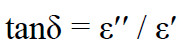
The observed reduction in tanδ with frequency is indicative of a transition from a loss system at low frequencies to a more stable dielectric response at higher frequencies. Tanδ increases with the fillers concentration, indicating increased dielectric losses due to the increased interfacial polarization and charge mobility. Overall, the results confirm that TiO2 nanoparticles improve the dielectric performance of the polymer blend, particularly at low frequencies, making the system suitable for dielectric and energy storage applications.
CONCLUSION
The results show that TiO2 insertion considerably alters the PVA/PVP blend’s electrical structure, as shown by the noticeable reduction in the optical band gap and the increased absorption in the visible region. Strong polymer–nanoparticle interactions are thought to cause the creation of localized states and an enhancement in defect density, which are responsible for this behavior. Improved light absorption and scattering inside the nanocomposite are further supported by the reduction in transmittance. Effective interfacial bonding between TiO2 and the polymer matrix is crucial for customizing the material’s characteristics, which is confirmed by FTIR analysis. Because of better phonon transmission, the thermal conductivity behaves optimally at intermediate loading, whereas greater concentrations cause agglomeration and increased interfacial resistance. As TiO2 content increases, dielectric characteristics show increased polarization and charge carrier effects, especially at low frequencies. For advanced functional applications, regulated TiO2 doping offers an effective way to maximize the optoelectronic, thermal, and dielectric performance of PVA/PVP-based nanocomposites.
CONFLICT OF INTEREST
The authors declare that there is no conflict of interests regarding the publication of this manuscript.
