
Document Type : Research Paper
INTRODUCTION
Interest in spatial quantification is increasing due to recent developments in epitaxial crystal growth methods, including molecular beam epitaxy, that have facilitated the formation of well-defined heterojunction interfaces [1,2]. Among these systems, quantum wires, where electrons may travel freely in one dimension while being constrained in the other two, have attracted considerable attention [3-5]. The emitted light wavelengths of nanowires, which are important in optoelectronic applications such as lasers and single-photon emitters, represent one of their characteristic optical properties and can be affected by quantum confinement effects and material composition.
Cylindrical nanowires provide a suitable approach for theoretical modeling due to the nature of radial confinement. In addition, the wire and surrounding semiconductor can have a finite band offset, which provides a stronger framework for the confinement of carriers [6,7].
CdTe/Cd1-xMnxTe belongs to the II–VI semiconductor alloy system; with variations in Mn, the system exhibits changes in its electronic behavior [8]. In particular, the band gap of Cd1-xMnxTe increases for more Mn doping [8,9]. Also, in the range of concentrations studied, experimental results of electron cyclotron resonance show an increase in the band edge of the conducting electron of effective mass with increasing Mn [10]. This is important to effective mass calculations, since the energy of confinement is directly related to the carrier’s effective mass. This is consistent with calculations of Cd1-xMnxTe done using the pseudopotential approach, which indicate that the effective mass of the holes and electron charge carriers change with Mn [11].
A semiconductor heterostructure with a finite barrier is more realistic than the case with an infinite barrier, since in the former case the barriers do not totally eliminate the carriers. Rather, in the presence of a finite band offset, the carriers’ wave functions can extend into the neighboring materials. For cylindrical quantum wires, Leyronas and Combescot reported analytical expressions of the bound state energies for finite barrier wells, wires and dots. It was shown that for various barrier heights and confinement sizes, their results were in excellent agreement with the previously published numerical results for the solutions of the corresponding transcendental equations [12].
The purpose of the present study is deliberately restricted to the nonmagnetic effective-mass limit. Although Cd1-xMnxTe is a diluted magnetic semiconductor and its full band structure can contain exchange-related effects, no magnetic-field, spin-exchange, or Zeeman term is introduced here. The calculation therefore isolates the size and alloy-composition effects that arise from the adopted effective masses, band-gap parameters, finite barrier, and geometric confinement.
This study explores the influence of quantum-confinement energies on the lowest three electron energy states (E₁, E₂, E₃) of cylindrical core-shell Cd₁₋ₓMnₓTe nanowires, focusing on the effects of cross-sectional area and Mn content. Through solving the effective-mass Schrödinger equation considering a finite potential barrier at the core–shell interface, it evaluates the quantum confinement characteristics, where the barrier height is obtained from the bandgap energy difference between the shell and core materials and varies with Mn composition.
The investigation considers Mn compositions of x = 0.20, 0.30 and x = 0.40, while the cross-sectional areas extend from 25 to 225 nm². It calculates the transmission coefficients corresponding to the first three energy levels to examine quantum tunneling of confined electrons through a finite potential barrier.
The study also calculates emission energy from the ground state to determine suitable emission wavelengths and examines the optical response through photoionization cross-sections.
Ultimately, it emphasizes how composition and structural dimensions determine the electrical and photonic characteristics of these nanowire structures, highlighting their potential for applications in electronic, sensing, as well as optoelectronic systems including semiconductor laser sources and nanoscale photonic systems.
THEORETICAL FRAMEWORKS
The Schrödinger equation, a cornerstone equation in quantum mechanics that depicts the free as well as confined motion of electrons within a potential barrier, is employed to determine the energy levels of electrons in quantum systems.
On this work, we investigate electron energy levels on cylindrical nanowires, where an infinite potential barrier restricts the electrons’ motion. Solutions of the Schrödinger wave equation for nanowires with finite potential barriers are also presented.
Quantum wires with cylindrical geometry energy spectrum
Here, we assume an electron confined within a cylindrical quantum wire having a finite length z and radius R, as illustrated in Fig. 1a, where the potential is zero inside the wire and infinite outside. Although limited in r and φ, the electron in the wire is free to move in the z direction. The time-independent wave equation has the following cylindrical coordinate system (r,φ,z) [5,13-15]:

Three different wave functions are multiplied using the separation-of-variables method to obtain the total wave function Ψ(r,φ,z).
It appears as follows:

Inserting this representation of Ψ(r,φ,z) will break Eq. 1 into the following three equations:
-The z equation in the free direction of motion is written as
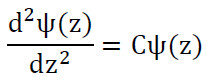
Normalizing the sinusoidal form of Eq. 3 subject to the boundary condition (0 ≤ 𝑧 < 𝐻) gives the normalized wave function ψ(z), where C is a constant.

Additionally, the eigenvalues’ free term will be:
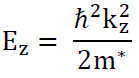
The wave vector in the z direction is represented by:
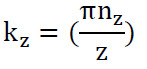
The second equation represents the angular wave equation, which is dependent on φ over the range 0≤φ≤2π.
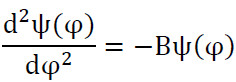
The angular equation’s solution, where B is a constant, takes the form of a normalized plane wave:
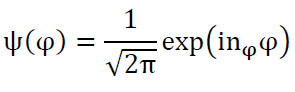
The azimuthal quantum number, denoted by nφ, is equal to 0,1,2,3.
Lastly, the equation for radial waves:

where Ec is the confinement energy value and wave vector:
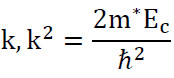
Eq. 10 is the Bessel differential equation, whose solution is given by the Bessel function, which approaches zero at the boundary [16–19] is the normalized wave function:
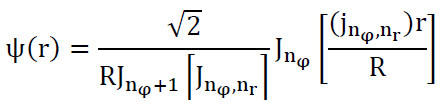
Where 0≤ r ≤ R. The radial quantum number is denoted by nr (nr=1,2,3,…), while the roots of the Bessel function are represented by j(nφ,nr). The confinement energy Ec is now obtained from the radial solution in the following form [20]:
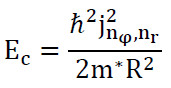
Now, the complete wave function is given by:

Furthermore, the total energy, also known as the dispersion energy, has the following form [21-24]:
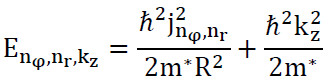
Once we begin determining the energy-level values, we select the appropriate values of j(nφ,nr) and the corresponding quantum numbers for each energy state, as discussed in the following section.
The electron confinement energy in a cylindrical core–shell nanowire
To characterize the energy profile of an electron confined within a cylindrical core–shell nanowire, we consider an electron restricted to the core region of radius R, as illustrated in Fig. 1b. The shell surrounding the core acts as a finite potential barrier, providing radial confinement for the electron. Assuming cylindrical symmetry and employing the effective-mass approximation, the time-independent Schrödinger equation governing an electron confined within the core along radial direction may be expressed as follows [25]:

Given the following, the shell creates a potential barrier with a finite height:
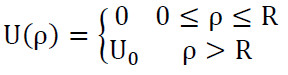
Where ρ is the separation between the place of interest and the wire axis’s center. We define a novel dimensionless parameter that is associated with the barrier potential through the relation in order to simplify the study [12].
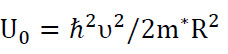
As we can already see from the characteristic energy scale associated with the barrier height ℏ2/2m* R2, a given barrier U0 between two semiconductors may appear high or low depending on the confinement extension. The electron confinement energy appears to have the same unit as U0, particularly, according to Eq. 18.

The radial Schrödinger equation can be solved numerically to express the energy parameter α, which determines the permitted electron energy levels enclosed inside the cylindrical core, using the dimensionless variable ν [12]:
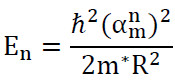
The energy levels of cylindrical wires are defined using two quantum numbers: n denotes the radial quantum number and ±m denotes the azimuthal quantum number, associated with angular momentum, (m = 0, 1, 2). The parameter αmax is given by the nth zero Z(n,m) of the Bessel function Jm corresponding to the (n,±m) levels, whereas the threshold νmin at which a level disappears is equal to zero for the ground state (without angular nodes) \((m = 0, n = 1)\) and \Z(n,m-1) for m≠0. The following final equation may then be used to get the energy parameter α associated with the electron energy level n in cylindrical nanowire structures:
Using Eqs. 17, 18, together with 20, the confinement energy of an electron En within a cylindrical nanowire having radius R and enclosed by a finite potential barrier of height U0 is as follows:
Quantum Tunneling and Transmission Coefficient
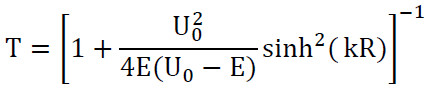
Classical theory states that an electron will always be reflected when its energy falls below the barrier height (E < U0); transmission will only occur when its energy exceeds the barrier height (E > U0). Nonetheless, a finite probability always exists for a particle to penetrate the barrier and proceed forward even when its energy remains below the barrier height; this phenomenon is referred to as quantum-mechanical tunneling [26-28]. The transmission coefficient, which represents the likelihood of tunneling, is influenced by the radius R of cylindrical wire as well as the electron’s energy level E. This dependence is described by the generic relation [13,14,16,17] for a one-dimensional finite-potential barrier:
Where,
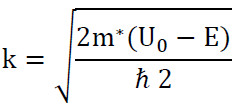
referred to as the attenuation constant in (nm⁻¹), describes the rate at which the wavefunction attenuates within a potential barrier during quantum tunneling. By demonstrating that the transmission coefficient reduces exponentially when the barrier width R becomes larger or the energy E becomes lower (with respect to U0, this formula highlights the substantial sensitivity of tunneling characteristics to the geometrical and material properties of the nanowire.
Emission Energy and Wavelength
Within nanowire structures, the emission wavelength may be accurately regulated through varying the composition of the active layer. This adjustment is accomplished by tuning both the fundamental bandgap of the material and the confinement of charge carriers within the nanowire. The correlation between confinement energy and the energy gap of each state in a nanowire EgQW is as follows [15,19]:

where ΔEe represents the electron confinement energy and ΔEh represents the hole confinement energy.
Next, use Eqs. 21 to determine the confinement energy for the electron and hole independently. Next, use Eq. 24 to determine the energy gap EgQW for the two wires.
This study demonstrates that the energy emission and, as a result, the wavelength of the light emitted are both influenced by the cross-sectional structure and material composition of a nanowire. The combined influence of quantum confinement and alloy composition lead the band gap to vary dramatically when the aluminum concentration (x) rises. This thus influences the emission wavelength. Using the relation of energy and wavelength of photons, the wavelength of emitted photons can be calculated like this [19,21]:
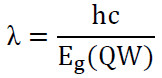
Here, h denotes Planck’s constant and c denotes the velocity of light. Due to the optical characteristics of nanowire structures, it is possible to create devices with greater control over their emission wavelengths. Tunability of the emission wavelength range is provided by alloy composition, and controlled by quantum size effects.
RESULTS AND DISCUSSION
The electronic energy spectrum and quantum confinement characteristics of cylindrical core-shell CdTe/Cd1-xMnxTe nanowires with Mn compositions of x = 0.2, 0.3, and 0.4 are examined in this section using theoretical models. The time-independent Schrödinger equation for cylindrical nanowires is solved under both infinite and finite potential barrier conditions in the effective mass approximation. First, the cross-sectional dimensions of infinitely deep cylindrical nanowires are studied in relation to the confinement and total energies.
Subsequently, a finite potential barrier is considered to provide a more realistic description of the core-shell structure, where the barrier height is determined from the difference between the bandgap energies corresponding to the core and shell materials.
For cross-sectional areas between 25 and 225 nm², the influence of material composition and cross-sectional area on the three lowest electron energy states, E₁, E₂, and E₃, are examined. Additionally, by computing the associated transmission probabilities corresponding to the various confined energy levels, the electron tunneling across the finite potential barrier is examined. Through calculating the electron-hole transition energies from the ground state and figuring out the appropriate emission wavelengths and photoionization cross-sections, the optical characteristics of the cylindrical nanowires are also investigated.
The electron and hole effective masses,

and

are among the material parameters utilized in the theoretical model. The conduction band offset [18] was used to compute the potential barrier height U0.

The direct bandgap energy for CdTe/Cd1-xMnxTe was calculated using [18]:

The obtained results provide a comprehensive understanding of the interplay between quantum confinement, material composition, wire dimensions, electron tunneling, and optical transitions, offering useful insights into the development and improvement of cylindrical semiconductor nanowires for potential optoelectronic and nanoscale device applications.
Fig. 2 illustrates the confinement energies corresponding to the initial three energy states together with the cross-sectional area of CdTe/Cd1-xMnxTe cylindrical core–shell nanowires, with the calculated energy eigenvalues computed via Eqs. 20 and 21. It is evident that when the cross-sectional area of the nanowires becomes larger, the confinement energy at all three levels diminish. Such behavior indicates that in larger wire dimensions, the strength of quantum confinement is decreased as expected.
For the two types of barriers: energy confinement is lower for a finite barrier than for an infinite barrier. For an infinite barrier, the wave function must be equal to zero when it reaches the core, which implies rigid boundary condition. For a finite barrier, the wave function is allowed to penetrate the shell, and therefore, quantum confinement is weakened. For small nanowire dimensions, which correspond to the strongest electronic confinement, energy confinement for the finite barrier is lower in comparison to the infinite barrier.
The figure shows that with the increase of the Mn content, the confinement energies increase. Increasing the Mn content increases the potential barrier (and the conduction band offset) and hence the confinement. This is in accordance with the principle that increasing the potential barrier increases confinement, and hence energy levels become more separated and increased. The effect of the structure is most pronounced at small wire dimensions, and it decreases as the wire dimensions become larger.
For the first three energy levels of CdTe/Cd1-xMnxTe with values of x at 0.20, 0.30, and 0.40, Fig. 3 displays the variation of the transmission coefficient with the cross-sectional area (A).
The wide variation in T values prevents a linear scale on the graph. Instead, the graph is presented on a logarithmic vertical scale.
Because of the sinh2(kR) term in Eq. 22, the graph illustrates the exponential decline of the transmission coefficient with an increase in wire cross-sectional area.
The decay constant
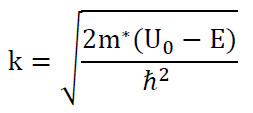
and the radial dimension R is related to the cross-sectional area by:
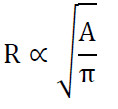
For small cross-sectional areas, the value of kR is small, where sinh(kR)≈kR, resulting in a relatively slow decay of transmission coefficient.
For large cross-sectional areas, where
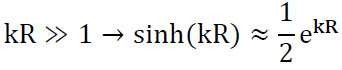
resulting in the exponential decay of transmission coefficient
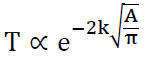
This illustrates the rapid decay of the quantum tunneling probability for a larger wire dimension. As the radial dimension of a wire increases, the transmission probability decreases for a given wire cross-sectional area, reflecting a decrease in the probability of tunneling of the electrons across the potential barrier.
For x = 0.20, as A goes from 25nm² to 225nm², the values for T decrease from 8.285*10⁻² to 1.27*10⁻⁶. At x = 0.40, corresponding values decrease from 5.64*10⁻³ to 5.11*10⁻¹⁰.
In terms of energy levels, the transmission coefficient rises as energy levels rise. Transmission coefficient values are most noticeable for the second excited state electron (E3), and are attributable to the potential barrier height and confinement energy (E3) interaction. This reduces the height of the potential barrier and increases the probability of quantum tunneling.
The concentration of manganese at a fixed cross section also is a control factor. An increase in x generally corresponds to a decrease in the transmission coefficient, which is more significant for E1, and in larger regions. For A = 225nm² and x = 0.20, the given values are approximately 1.27*10⁻⁶ and for x = 0.30 and 0.40, the values are approximately 2.00 *10⁻⁸ and 5.11*10⁻⁹, respectively. Thus, an increase in the nanowire size has a similar qualitative effect as an increase in the concentration of the manganese: both increase the confinement of the electrons in the CdTe core.
Lastly, ground-state emission wavelengths were calculated for different nanowire sizes and Mn concentrations as shown in Fig. 4. The emission wavelengths increase for a larger cross-sectional area due to an increasing range of wavelengths caused by a decrease in quantum confinement with increasing wire size.
A redshift is the results of this. However, when the concentration of Mn increases, the emission wavelengths blue shift. This behavior is explained by the fact that when x increases, the electronic characteristics of Cd1-xMnxTe change.
For the finite-barrier case and for A = 225nm², the calculated emission wavelengths are 638.066, 589.774, and 548.425 nm for x = 0.20, 0.30, and 0.40, respectively. Therefore, an increase in x from 0.20 to 0.40 causes approximately an 89.6 nm change in the ground-state emission wavelength for the widest cross-sectional area. For the smallest cross-sectional area, the calculated ground-state emission wavelengths for x = 0.20, 0.30, and 0.40 are 615.651, 566.556, and 526.169 nm, respectively. Thus, for a fixed composition of the alloy, nanowire size can still shift emission wavelength.
The emission wavelength for the finite barrier is slightly longer than the emission wavelength for the infinite barrier for the same cross-sectional area and composition. This is due to the finite barrier confinement being less than that of the infinite barrier. Thus, a slight redshift in the emission wavelength occurs. In general, it can be concluded that the emission wavelength can be changed by altering the nanowire size or Mn concentration.
CONCLUSION
This study reviewed the variations in the electron energy spectrum associated with charge transport in CdTe/Cd1-xMnx Te core-shell nanowires. We studied the impact of changes in geometric factors and concentration of manganese (Mn) on the energy spectrum. We found that the confinement energy levels drop when the cross-sectional area of the nanowire increases. In this case, we expect more energy levels to form and the confinement to be weak. When the concentration of Mn is increased, the potential barrier increases, and consequently, the energy levels also increase. The probability of quantum tunneling depends on the cross-sectional area, energy levels, and the composition of the alloy.
The probability of tunneling is increased when the cross sectional area and energy levels are high, and the composition of the alloy is low. In the case of Mn, if the composition of the alloy is increased, the probability of quantum tunneling is decreased. Among the different factors studied, the composition of Mn in the alloy is the dominating factor that changes the emission wavelength and the shift of the emission bands. Our results provide insights for controlling and designing nanostructures to make light emitting devices that can be tuned in order to have a control on the wavelength of emitted light, as well as make improvement in other optical systems.
CONFLICT OF INTEREST
The authors declare that there is no conflict of interests regarding the publication of this manuscript.
